Our thermal regulation solution material provides passive energy absorption, thermal homogeneity, and performance improvement for your product requirements.
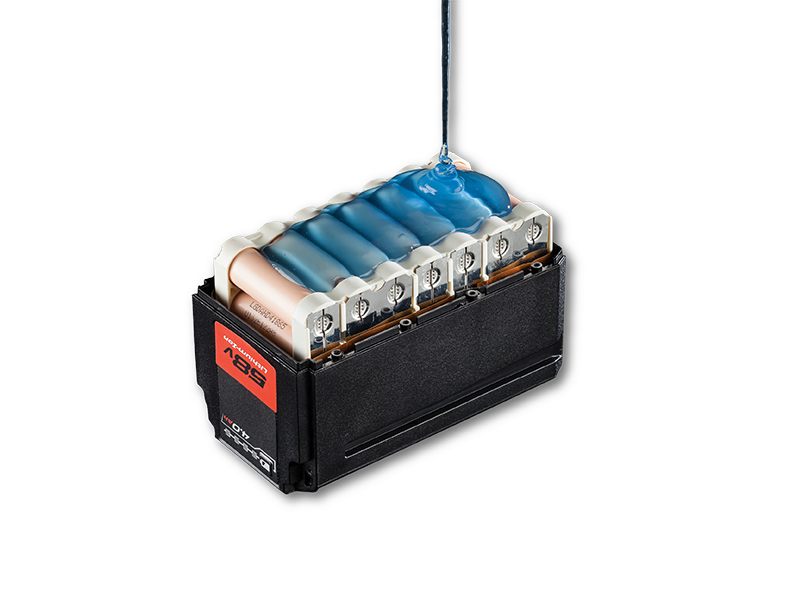
Fill & Flow is designed to easily fill enclosed and small-cavity systems by completely flowing around, encompassing, and contacting all surfaces of fully enclosed cells and packs.
Take a closer look at our core technology designed for your IP65-rated or higher battery pack.
LHS F&F-89
LHS F&F-90R
LHS F&F-91
LHS F&F-92
LHS F&F-93
LHS F&F-89»
LHS F&F-90R»
LHS F&F-91»
LHS F&F-92»
LHS F&F-93»
Temperature (PPT)
35-39 °C
Latent Heat
210-230 kJ/kg
Specific Gravity @ 22 °C
0.8
Viscosity above PPT (cps)
25-100
Operating Temp. Range
-10–120 °C
Volume Resistivity
1.1 x 10^5 Ωcm
Dielectric Constant
2.04
Dielectric Strength**
21.71 MV/m
RoHS Compliance
Compliant
Avg. Specific Heat Capacity, Cp–Below PTT *
1.85 J/g °C
Avg. Specific Heat Capacity, Cp—Above PPT*
2.35 J/g °C
Avg. Thermal Conductivity, – Below PPT*
0.35 W/m·k
Avg. Thermal Conductivity, – Above PPT*
0.25 W/m·k
*Viscosity determined at 20°C above the transition temperature.
*Other phase transition temperatures up to 130°C are available.
*Similar to most solid and liquid materials, the specific heat capacity and thermal conductivity have insignificant change above and below the transition temperature
**Tested at 3 mm thickness
Temperature (PPT)
42-46 °C
Latent Heat
180-200 kJ/kg
Specific Gravity @ 22 °C
0.8
Viscosity above PPT (cps)
25-100
Operating Temp. Range
-10–120 °C
Volume Resistivity
4-5 x 10^13 Ωcm
Dielectric Constant
3.05
Dielectric Strength**
36.63 MV/m
RoHS Compliance
Compliant
Avg. Specific Heat Capacity, Cp–Below PTT *
1.90 J/g °C
Avg. Specific Heat Capacity, Cp—Above PPT*
2.45 J/g °C
Avg. Thermal Conductivity, – Below PPT*
0.35 W/m·k
Avg. Thermal Conductivity, – Above PPT*
0.25 W/m·k
*Viscosity determined at 20°C above the transition temperature.
*Other phase transition temperatures up to 130°C are available.
*Similar to most solid and liquid materials, the specific heat capacity and thermal conductivity have insignificant change above and below the transition temperature
**Tested at 3 mm thickness
Temperature (PPT)
49-51 °C
Latent Heat
200-220 kJ/kg
Specific Gravity @ 22 °C
0.8
Viscosity above PPT (cps)
25-100
Operating Temp. Range
-10–120 °C
Volume Resistivity
4-5 x 10^13 Ωcm
Dielectric Constant
3.05
Dielectric Strength**
36.63 MV/m
RoHS Compliance
Compliant
Avg. Specific Heat Capacity, Cp–Below PTT *
1.90 J/g °C
Avg. Specific Heat Capacity, Cp—Above PPT*
2.45 J/g °C
Avg. Thermal Conductivity, – Below PPT*
0.35 W/m·k
Avg. Thermal Conductivity, – Above PPT*
0.25 W/m·k
*Viscosity determined at 20°C above the transition temperature.
*Other phase transition temperatures up to 130°C are available.
*Similar to most solid and liquid materials, the specific heat capacity and thermal conductivity have insignificant change above and below the transition temperature
**Tested at 3 mm thickness
Temperature (PPT)
53-57 °C
Latent Heat
210-230 kJ/kg
Specific Gravity @ 22 °C
0.8
Viscosity above PPT (cps)
25-100
Operating Temp. Range
-10–120 °C
Volume Resistivity
4-5 x 10^13 Ωcm
Dielectric Constant
3.05
Dielectric Strength**
36.63 MV/m
RoHS Compliance
Compliant
Avg. Specific Heat Capacity, Cp–Below PTT *
1.90 J/g °C
Avg. Specific Heat Capacity, Cp—Above PPT*
2.45 J/g °C
Avg. Thermal Conductivity, – Below PPT*
0.35 W/m·k
Avg. Thermal Conductivity, – Above PPT*
0.25 W/m·k
*Viscosity determined at 20°C above the transition temperature.
*Other phase transition temperatures up to 130°C are available.
*Similar to most solid and liquid materials, the specific heat capacity and thermal conductivity have insignificant change above and below the transition temperature
**Tested at 3 mm thickness
Temperature (PPT)
59-63 °C
Latent Heat
210-230 kJ/kg
Specific Gravity @ 22 °C
0.8
Viscosity above PPT (cps)
25-100
Operating Temp. Range
-10–120 °C
Volume Resistivity
4-5 x 10^13 Ωcm
Dielectric Constant
3.05
Dielectric Strength**
36.63 MV/m
RoHS Compliance
Compliant
Avg. Specific Heat Capacity, Cp–Below PTT *
1.90 J/g °C
Avg. Specific Heat Capacity, Cp—Above PPT*
2.45 J/g °C
Avg. Thermal Conductivity, – Below PPT*
0.35 W/m·k
Avg. Thermal Conductivity, – Above PPT*
0.25 W/m·k
*Viscosity determined at 20°C above the transition temperature.
*Other phase transition temperatures up to 130°C are available.
*Similar to most solid and liquid materials, the specific heat capacity and thermal conductivity have insignificant change above and below the transition temperature


.jpg?width=1200&length=1200&name=Elastomer_Pellets%20(1).jpg)